Next-Generation Anti-Cheat Architecture: The 2026 Paradigm Shift to Server-Side Anomaly Detection
 Pernithia Galnith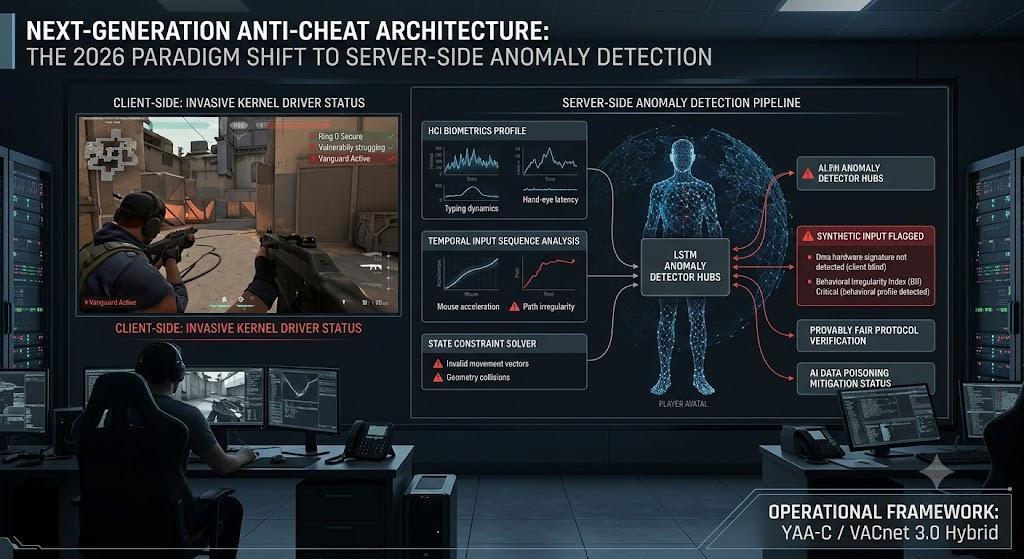
The Billion-Dollar Bleed: Why Ring 0 is Officially Dead
A $260 billion valuation means nothing if your player base abandons ship over aimbots. We need to have an honest conversation about the actual stakes. The entire live-service financial ecosystem survives only as long as competitive integrity holds up under pressure. A single high-profile cheating scandal violently triggers a 15% to 30% player attrition rate. Esports franchises get permanently nuked by that kind of exodus. Because live tournaments boast prize pools north of $50 million, the financial incentives to build algorithmic exploits massively outpace traditional cybersecurity budgets. We are watching the anti-cheat software market hyper-scale to a projected $8.7 billion over the next decade. Publishers can no longer treat this infrastructure as a peripheral IT cost. It is the absolute core of product viability.
For the last five years, the industry's default defensive posture was a brute-force escalation into the operating system. Vanguard and Ricochet shoved proprietary Ring 0 drivers deep into the end-user's kernel memory. The objective was to establish a trusted computing base. You hit a brick wall, however, when you realize you can never actually secure a host machine if the adversary holds physical access to the hardware. The July 2024 global IT outage proved exactly why deeply embedded kernel agents act as a systemic liability. That disaster crashed 8.5 million devices and immediately prompted Microsoft's Windows Resiliency Initiative. Redmond is now systematically locking third-party security vendors out of the kernel to prevent catastrophic system panics. This technical eviction—combined with intense regulatory friction like Ubisoft's recent GDPR privacy complaints—means the traditional client-side defense model is effectively dead in the water.
Hardware Bypasses and the $6,000 Paperweight Problem
Windows OS mandates are only half the crisis. Modern cheat developers abandoned software-based memory injection a long time ago. Top-tier illicit operations rely entirely on Direct Memory Access (DMA) hardware. Adversaries slot a specialized FPGA PCIe card directly into the gaming motherboard. A secondary laptop then passively reads the game's physical memory over the PCIe bus. Since no malicious executables touch the primary machine's storage or CPU, traditional signature-based scanners like BattlEye look at the system and find absolutely nothing to flag. The malware simply does not exist on the gaming rig.
Security architectures normally trust the Input-Output Memory Management Unit—or IOMMU—to play bouncer. That specific hardware component exists solely to dictate exactly which physical memory addresses a rogue PCIe peripheral is allowed to read. Pre-Boot DMA Protection should theoretically lock this down before anti-cheat even loads. Riot Games ripped the lid off a massive vulnerability here in late 2025. You had massive vendors—think Asus and Gigabyte—shipping UEFI firmware that essentially gaslit the operating system. Their BIOS setups swore up and down that DMA Protection was fully locked down; meanwhile, the actual hardware gateway was passed out drunk at the wheel.
That failure left a millisecond gap during the boot sequence. DMA hardware exploited that tiny window to inject persistent code into memory before Vanguard could even initialize. Riot escalated the conflict in May 2026 by deploying an aggressive client update. They intentionally triggered forced page faults to corrupt the firmware of malicious PCIe devices. They essentially turned $6,000 cheat hardware setups into permanent paperweights. This scorched-earth tactic highlighted the absolute desperation of client-side enforcement, sparking massive ethical debates about corporate software destroying personal property.
Stealing the Blueprint: Cryptography and the Casino Pivot
Software cannot secure a physically compromised machine. Esports engineers finally accepted this bitter pill. They began cannibalizing security architectures from adjacent, highly lucrative industries. Think about platforms processing billions in hostile digital transactions daily. The transition to server-side anomaly detection completely lifts its playbook from the cryptographic verification systems deployed by a regulated digital casino to guarantee provably fair outcomes. In those high-stakes environments, operators never trust the client's browser. The server forces the client to commit to a mathematically verifiable cryptographic hash before any digital transaction ever executes. This usually involves a complex mix of server seeds, client entropy, and sequential nonces.
Competitive multiplayer titles are now running this exact protocol via systems like the Trusted Verification of Game Protocol (TVGP). The server no longer asks if unauthorized software is hiding on the local hard drive. It strictly evaluates whether the client's telemetry is mathematically possible. High-speed constraint solvers symbolically execute the client's logic in real time. If a player’s avatar attempts a movement vector that defies the server's authoritative physics engine, the packet drops instantly. This zero-trust architecture completely neutralizes the need for invasive client-side monitoring. It relies entirely on cold, verifiable math.
Biometric Ghosting and the Splat Effect
Hardware bypasses and Computer Vision (CV) bots require zero memory access. The defense must therefore focus entirely on the biological output of the human controlling the input device. External HDMI capture cards feed video to object-detection algorithms. Those bots emulate raw USB inputs back into the host. Human-Computer Interaction (HCI) algorithms built by firms like Anybrain are quietly fighting this by compiling biometric profiles. Typing dynamics, mouse acceleration curves, and the natural physiological tremors in a player's wrist broadcast to the server every single tick. Synthetic perfection becomes the ultimate red flag.
Old-school statistical models bleed out through a brutal 2.68% False Positive Rate. Ban a few thousand legitimate players by accident, and watch your live-service retention numbers completely crater. Engineers had to scrap the old heuristics entirely; they pivoted hard into Long Short-Term Memory recurrent neural networks—specifically deploying setups like the YAA-C framework to stop the bleeding. These deep-learning models evaluate 128-tick temporal sequences. The AI analyzes 56 ticks before a damage event and 24 ticks after. It successfully differentiates an elite player's natural flick-shot from an aimbot's linear, robotic trajectory.
With the False Positive Rate crushed below 0.97%, automated server-side interventions are radically changing live matchmaking. Activision's Ricochet system actively mitigates accounts on the server side to gather intelligence. Illicit accounts suddenly find their bullets dealing zero damage via "Damage Shield." Sometimes they experience "Splat," where the server modifies physics to make their fall damage instantly lethal upon spawning. The cheaters are left completely powerless against server-side authority.
Poisoning the Well: The Quiet Catastrophe of Model Drift
You might assume massive cloud-based AI represents the ultimate checkmate. The arms race simply migrated to a different, less visible battlefield. Neural networks like VACnet 3.0 continuously train on live matchmaking data to establish a baseline of human capability. That operational requirement makes them incredibly vulnerable to data poisoning.
Closet cheaters deploy heavily humanized soft-aim algorithms to quietly fly under the radar. They bake randomized micro-delays, spatial smoothing, and artificial inaccuracy right into the code. Thousands of hours of high-ranking competitive play are logged by these accounts. They operate entirely off undetectable DMA hardware that sidesteps the kernel.
Machine learning models greedily swallow this spoofed telemetry. They look at the soft-aim data and incorrectly label it as the work of a highly skilled human. Fast forward through a few training cycles, and that slow drip of bad data triggers irreversible model drift. The AI gradually normalizes superhuman reaction times. Its internal sensitivity threshold shifts upward until blatant snap-aim behaviors no longer trigger an automated ban. Security operations centers are realizing a harsh truth about machine learning today. The algorithm is only as reliable as the purity of its reference data. As we move into the next fiscal quarter, competitive integrity won't be defined by who writes the most intrusive rootkit. The true victors will be the data engineers who can lock algorithms to unyielding biological limits—before adversaries successfully rewrite the mathematical definition of what it means to be human.