How World Cup Coaches Are Using the Same Performance Tools as Esports Teams
 Mirathor Quellith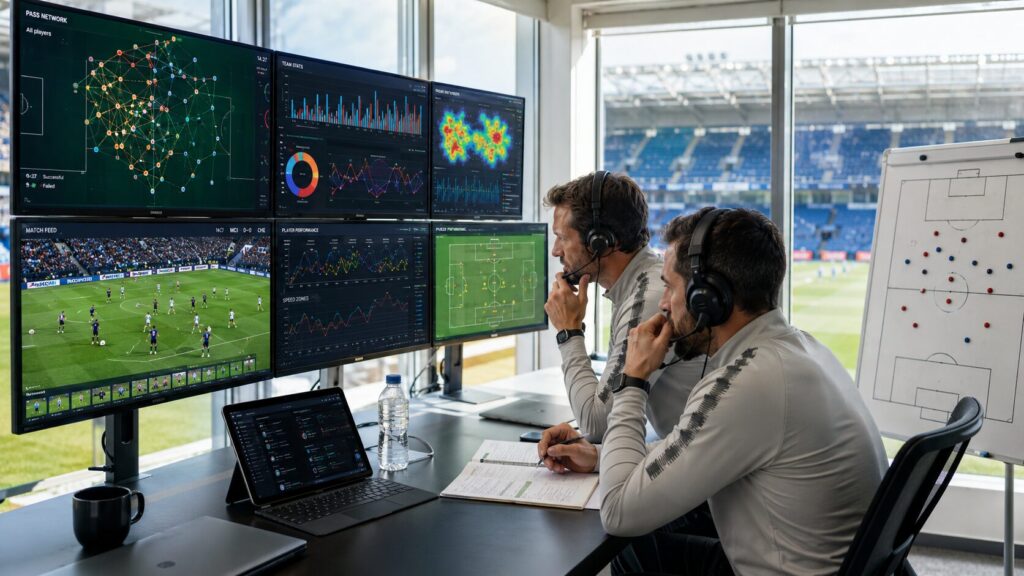
When Gianni Infantino and Lenovo CEO Yuanqing Yang walked onto the Sphere stage in Las Vegas on January 7, 2026, the headline announcement was a tool called Football AI Pro. According to FIFA’s official release, the generative AI knowledge assistant will be available to all 48 national teams competing in Canada, Mexico and the United States, analyzing “hundreds of millions of FIFA-owned and -organised football data points to generate validated insights in text, video, graphs and 3D visualisations”. To football reporters in the room, this sounded like a leap. To anyone who has spent time inside a top-tier Valorant or League of Legends bootcamp, it sounded like something else entirely: a workflow they have been running for years.
AI is changing the world, and football and esports are no exception. For this very reason, the 2026 World Cup is set to be a truly one-of-a-kind event, likely marking the dawn of a new era in the integration of technology and sport. That is also why the topics explored in this article may be especially compelling for football fans and bettors eagerly waiting to experience the thrill of placing wagers this summer on the best World Cup betting sites.
The Tools That Suddenly Look Alike
Strip away the branding and Football AI Pro is conceptually familiar. As Lenovo’s StoryHub describes it, the system “orchestrates multiple agents to scour millions of data points, analyze over 2,000 different metrics and deliver rapid insights” so that analysts can compare team patterns and coaches can test tactical changes against an opponent’s profile. That is, structurally, what platforms like Mobalytics, Insights.gg and iTero.gg have been doing for esports coaches since the late 2010s. Mobalytics, which counts T1 among its investors, runs what it calls the Gamer Performance Index, auto-tagging behavioral patterns into labels like “Aggressive Laner” or “Vision Controller” so coaches can intervene with data, not vibes. Insights.gg automatically detects highlight moments (kills, deaths, objectives) and powers collaborative VOD review across League of Legends, Valorant and CS2.
The TechTimes 2025 industry survey notes that professional teams in CS2, Valorant and Dota 2 “rely on it to gain small but decisive advantages” through pose estimation, biometric dashboards and predictive draft analytics. The convergence is real. But the framing that esports got there first and football is catching up only tells half the story.
What Esports Has Genuinely Pioneered
The honest accounting: esports moved earlier on three things football is now scaling. The first is systematic VOD review as daily habit. A 2025 CHI Conference observation study of an elite League of Legends academy logged 112 hours of coaching dialogue and found that post-game replay analysis is the structural backbone of every session. Footballers historically reviewed clips in batches around match days. Auto-tagging platforms like Hudl and StatsBomb are now pushing top clubs toward the esports cadence of granular, almost-continuous review.
The second is individualized performance dashboards. Esports players have grown up with per-action telemetry. A football midfielder’s heatmap is coarse by comparison, and Football AI Pro‘s promise of “personalised match analyses” for players, as Computer Weekly reported in January 2026, is football reaching for what esports normalized a decade ago. The third is in-competition biometrics. TechTimes documents that heart rate variability in Apex Legends “correlates with clutch performance at 0.85 precision” and that pose estimation actively tracks player posture during scrims. Football regulations still keep most live biometrics out of matches.
Where Football Is Actually Ahead
Here is where the brief most observers are running needs revising. On spatial tactical modeling, football is in front. In 2024, Liverpool FC and Google DeepMind published TacticAI in Nature Communications, a geometric deep learning system for corner-kick analysis. The headline finding: football experts at Liverpool preferred TacticAI’s suggestions to existing tactics 90% of the time. Brentford and FC Midtjylland built recruitment empires on expected goals and pressing efficiency. Liverpool uses AI to assess “football IQ” traits like positioning and reaction time as scouting criteria, according to industry analysis from Zone14 (March 2025). No esports title has produced an equivalent to TacticAI for collective spatial behavior. The granular data is there. The geometric modeling of eleven interacting bodies on a continuous pitch is genuinely harder than mapping five champions in a discrete map, and football has invested longer in solving it.
The Real Convergence: Sport Science Going the Other Way
The more interesting story is the reverse migration. Esports organizations are systematically importing the staff structures that European football federations spent decades building. Fnatic announced its “High Performance Unit” after a $10 million funding round, hiring sports scientists, nutritionists and fitness coaches to study how sleep and stress affect its 60-player roster. The model is now standard: Team Liquid, Cloud9, FaZe Clan, G2 Esports and Astralis all employ sport psychologists or certified mental performance consultants.
Astralis is the canonical case. The Danish Counter-Strike organization hired Mia Stellberg, a sport psychologist with an Olympic background, before the title runs that made them the most dominant CS:GO team in history. The role she described to HLTV (individual, team-morale and coaching work) maps directly onto the structure of a national football federation’s psychology department. The April 2026 issue of APA Monitor documents what is now a mainstream pathway: chartered sport psychologists like Benjamin Sharpe at the University of Chichester are moving fluidly between esports and traditional sports, applying the same evidence base to both. A 2024 scoping review published in MDPI’s Applied Sciences explicitly calls on esports to adopt Matveyev-style periodization, taper protocols and load monitoring, the same frameworks built for World Cup preparation since the 1950s. The 2025 University of Chichester study identified 51 distinct stress factors facing professional esports players, mirroring those documented in professional footballers and rugby players. Burnout among LCK pros has been studied with the same Athletic Burnout Scale used on conventional athletes.
Two Sports, Converging From Opposite Directions
The convergence is real, but it is not symmetric. Football is importing speed of iteration, VOD culture and the democratization of analytical tools. Football AI Pro’s most radical feature is not its sophistication. It is the fact that Curaçao and Cabo Verde, two of the smallest nations ever to qualify, will use the same instrument as Brazil. That kind of centrally distributed parity does not exist in esports, where Riot Games does not hand every Valorant team an analytical platform. Esports is importing periodization, multidisciplinary staff and the science of preparing for a single peak. Knockout tournaments at LAN events resemble World Cup brackets more than they resemble league seasons, and the sports science built for the latter is finally being applied to the former. The question for the 2026 World Cup is not whether AI changes football. It is whether the 48 teams given identical tools produce more competitive matches than the 32 teams that played in Qatar without them. The answer, like everything in football and esports, will arrive in the data.