Fanfiction Writing Prompt Generators Compared for Realistic Story Ideas in 2026
 Pernithia Galnith
Fanfiction keeps booming. Archive of Our Own already hosts more than 17 million stories across 77,000 fandoms, and the count rises daily. Yet a blank page can still stop any writer cold.
So we ran a two-week, cross-fandom stress test—mashing up Star Wars, Harry Potter, and Marvel—to see which AI prompt generators truly spark canon-true ideas.
Here’s what made the final cut: three tools that preserve continuity, hand you real creative control, and never police your tropes. Ready to pick your muse?
How we picked the winners
We didn’t rely on marketing copy or quick demo videos. For two weeks we lived inside each generator, firing crossover prompts, logging memory slips, and noting every time a character drifted off-voice.
First we built the same five-chapter Star Wars meets Hogwarts scenario in every tool. Short context windows dropped early plot clues, while stronger engines carried side jokes from Chapter 1 to the finale.
Next we graded each platform on five weighted factors:
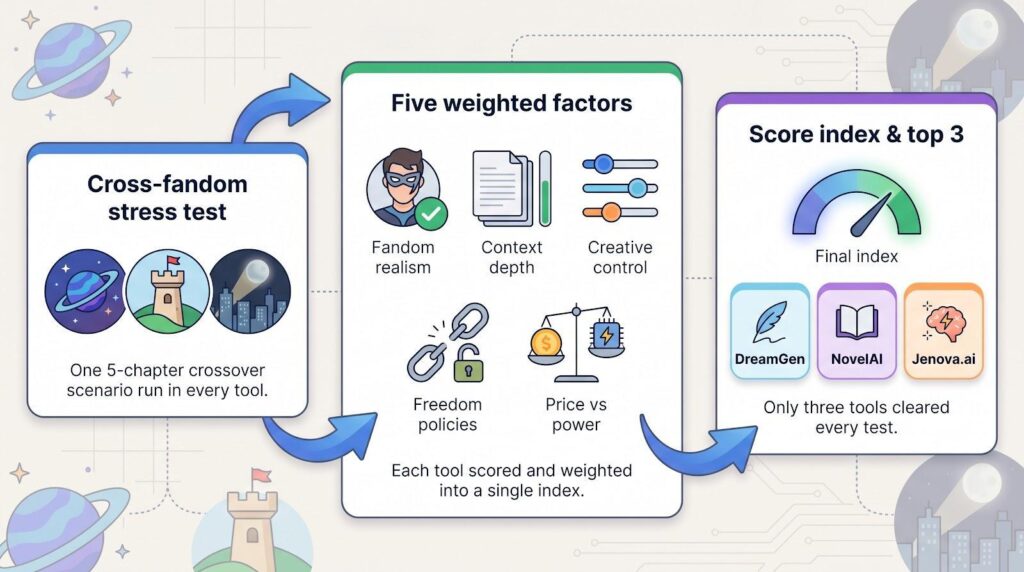
- Fandom realism: does Hermione still sound like Hermione after 3 000 words?
- Context depth: token capacity plus any cross-session memory. DreamGen sees up to 30 000 tokens at once.
- Creative control: prompt steering, role-play toggles, or model switching.
- Freedom policies: no hard blocks on common fanfic themes.
- Price versus power: subscription tiers, free credits, and hidden caps.
We rolled those scores into a single index and checked the math against Reddit and Discord chatter.
Only three tools cleared every test. They keep canon tight, stay out of your way, and still cost less than a monthly streaming plan.
Next: the generator that took first place.
Why just three picks?
You’ve seen the oversized “Top 10” lists packed with half-abandoned tools last updated in 2022. We cut the clutter.
During testing, most services failed basic fandom checks: characters drifted out of voice, context windows collapsed, or content filters blocked a mild Reylo kiss. Any tool that stumbled there never made the scoreboard.
That strict filter left three generators that deliver professional-grade prompts today. The payoff for you: zero time lost on mediocre options, every minute spent on solutions that work.
1. DreamGen: unfiltered writing partner for authors who dislike guardrails
DreamGen feels less like a chatbot and more like a private writers’ room that always says “yes, and…”. Fire it up, paste one line, and this online story generator for fan fiction opens Story Mode, an editor that grows your draft paragraph by paragraph while keeping your voice intact.
Memory is the headline feature. On the Pro tier the AI sees up to 30 000 tokens at once (about a 100-page novella), so it can recall an off-hand joke from Chapter 1 when you resolve it in Chapter 12 (see the DreamGen pricing page). That continuity matters when you juggle Force lore and Hogwarts politics in the same scene.
Control tools:
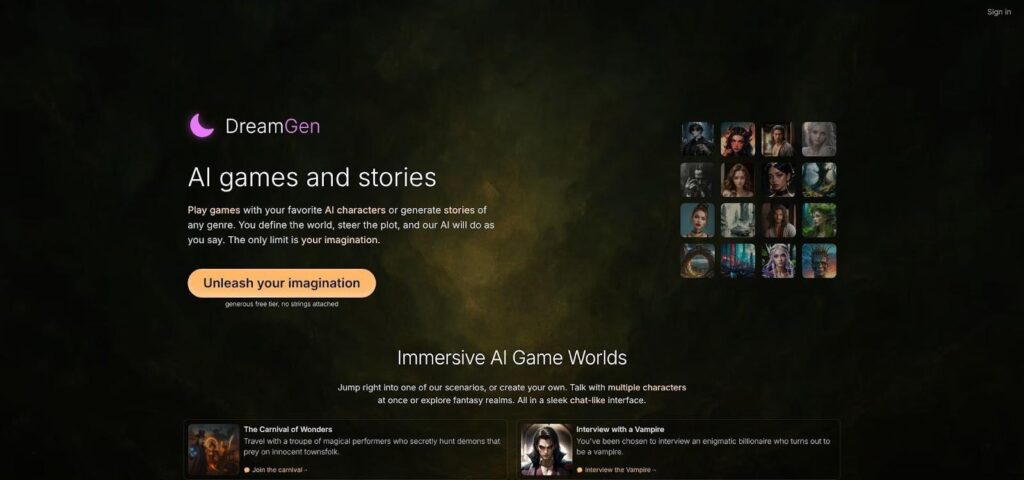
DreamGen Story Mode fanfiction writing interface screenshot
- Drop inline stage directions (“Make Hermione duel a Mandalorian”) and watch the text pivot smoothly.
- Switch to Role-Play Mode to test banter before folding it into prose.
- Pin key facts in a Scenario Codex so the AI keeps your AU timeline straight.
- Spark new ideas with its prompt search, which filters thousands of popular Reddit writing prompts by fandom and theme.
Reviewers on the fandom review site Declom highlight its “no rules, no restrictions” approach, meaning your angsty Sith romance will not trigger a content warning mid-draft. For seasoned fan-authors that freedom is priceless.
Pricing lands in the middle. A generous free tier lets you experiment, then plans start at $8 for hobbyists and rise to about $40 for the full context window. Given the memory and steering tools, the cost is attractive if you write anything longer than a one-shot.
Bottom line: pick DreamGen when you want a co-writer that tracks every plot thread, respects your creative choices, and turns a half-formed crossover into a scene that sings.
2. NovelAI: polished prose and a lorebook that never sleeps
If DreamGen is the wild creative sandbox, NovelAI is the practiced co-author who respects every beat sheet you hand over.

NovelAI fanfiction writing interface with Lorebook screenshot
Open a fresh project and the interface fades into the background. You type a line, the AI continues in smooth, novel-ready prose, and you decide what stays. It feels like pair writing with a disciplined friend who has read stacks of genre fiction and still recalls the rhythm of dialogue when you are tired on a Tuesday night.
Consistency is the highlight. Add birthdays, spell mechanics, or a quirky speech tag to the built-in Lorebook, and NovelAI threads them into future paragraphs without a reminder. In a 25-chapter space-opera AU it kept an alien slang term intact across 18 000 words and three time jumps, saving hours of back-scrolling.
Memory has limits. The context window reaches 36 000 tokens on the top tier, and sprawling epics still benefit from the occasional user summary. Paired with the Lorebook, though, long-form cohesion stayed stronger than expected.
Control lives in small, satisfying tweaks. Switch among proprietary models such as Xialong for richer language or Kayra for speed, then nudge creativity with temperature dials or style tags (#Humor, #Noir). No visual clutter, no pop-ups, just you and the page.
Trade-offs? NovelAI will not guide you with outline wizards, and the free trial ends quickly. Serious use starts near ten dollars a month and rises to the mid-twenties for unlimited daily generations. For writers who prize sentence-level quality over fancy dashboards, that fee is an easy sell.
Bottom line: choose NovelAI when you care most about silky prose, private drafts, and a memory system that keeps every character in character, letting you focus on plot twists instead of continuity policing.
3. Jenova.ai: multi-model brain built for marathon fics
Jenova approaches fanfiction like an editor with a server rack. Instead of one model, you get a panel of heavy hitters: GPT-5.4 for snappy banter, Claude Opus for emotional nuance, and Gemini for lore depth. Swap engines mid-scene the way a filmmaker changes lenses, matching each model to the task at hand.

Jenova.ai multi-model fanfiction writing dashboard screenshot
Long-term memory sets Jenova apart. The system stores character sheets, timeline notes, and voice profiles between sessions, then feeds key details back automatically. We paused a test story for a week; when we returned, the AI still remembered a side character’s broken arm and wrote the sling into the reunion hug. No copy-paste rituals needed.
The interface leans pro grade. You’ll see meters for narrative tension, sliders for trope density, and a Prompt Assistant that interviews you until your half-formed idea becomes a tight brief. The learning curve is real, but Jenova rewards writers who enjoy fine-tuning every knob before they hit generate.
Content freedom matches DreamGen. All ratings are welcome as long as the material is legal, so darker plots or spicy romance flow without interruption.
Cost sits higher, at about $20 a month for unlimited writing, but that single fee unlocks every frontier model and the deep memory stack. If you plan a 150 000-word multiverse crossover, the investment pays for itself in continuity sanity.
Bottom line: pick Jenova when you’re planning an epic saga, crave surgical control over style, and want an AI room full of specialists rather than one generalist co-writer.
How the top three stack up at a glance
You now know what each tool feels like in the trenches. Still, it helps to see the big differences side by side, especially if you skim articles during lunch and need a fast verdict.
The grid below compares the features writers ask about most: fandom realism, memory, creative control, content freedom, and price. Use it as a quick guide before you commit a weekend to testing.
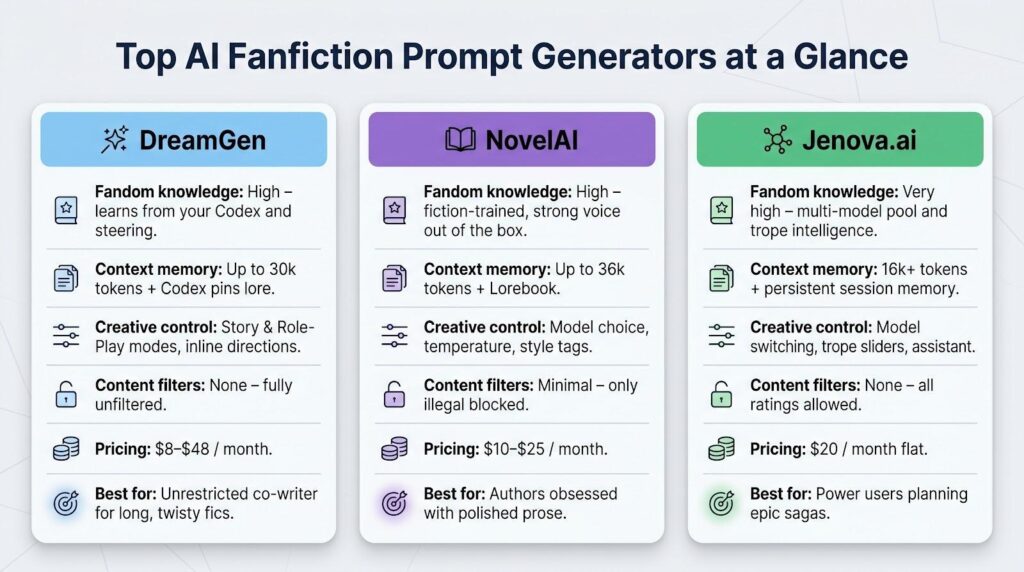
| Feature | DreamGen | NovelAI | Jenova.ai |
| Fandom knowledge | High. Learns from your Codex and follows steering with near-canon tone | High. Fiction-trained models nail voice out of the box | Very high. Multi-model pool plus trope intelligence |
| Context memory | Up to 30 000 tokens on Pro; Codex pins lore | Up to 36 000 tokens on Opus; Lorebook fills gaps | 16 000+ tokens plus persistent cross-session memory |
| Creative control | Story vs. Role-Play modes, inline stage directions | Model choice, temperature and tag tweaks | Model switching, trope sliders, prompt assistant |
| Content filters | None; fully unfiltered | Minimal; only illegal content blocked | None; all ratings allowed |
| Free tier | Yes, daily credits | Short trial only | Yes, usage-capped |
| Paid pricing (USD) | $8–$48 monthly across three tiers | $10–$25 across three tiers | $20 flat for full power |
| Best for | Writers who want an unrestricted co-writer that remembers every plot point | Authors who prize polished prose and simple, private workflow | Power users crafting epic sagas who like fine-tuning every knob |
Scan the row that matters most to you—memory, filters, or cost—and you’ll see which generator earns a test drive first.
Which generator is right for you?
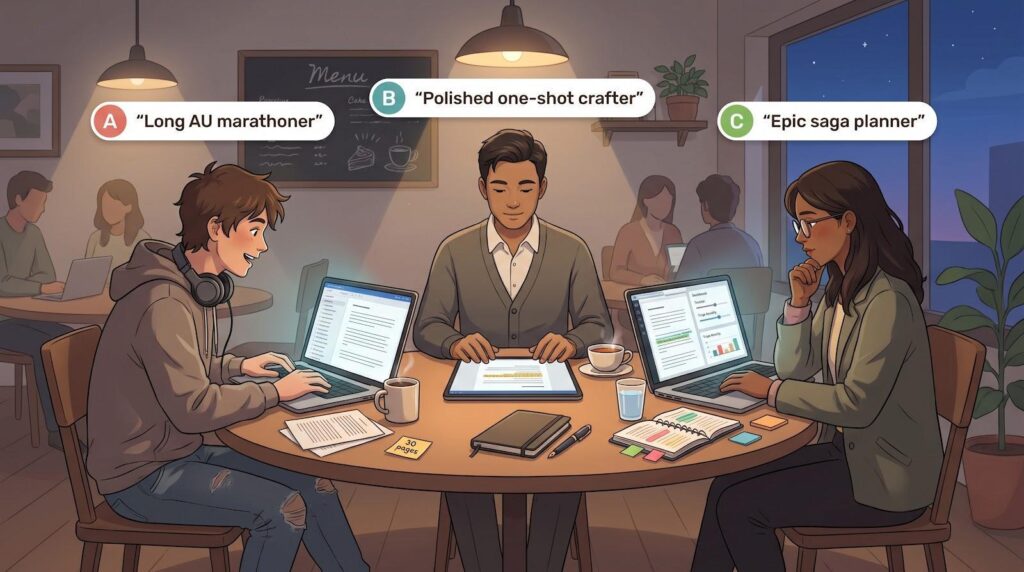
Picture three writers at a café.
The first crafts 30-page AUs every NaNoWriMo and dislikes any content gatekeeping. That writer pairs well with DreamGen: its wide context window prevents missed plot threads, and the unfiltered policy keeps the muse free.
The second turns out tight 5 000-word one-shots after work, fusses over sentence rhythm, and wants zero interface clutter. NovelAI fits that routine. Open a document, adjust a temperature knob, and let Kayra find the cadence.
The third maps out a trilogy, loves spreadsheets, and tweaks story stats like a gamer tuning gear. Jenova.ai rewards that mindset with model switching and session memory that spans months.
Ask yourself:
- How long is the story you’re drafting today?
- Do you prefer quick immersion or detailed configuration?
- Is total creative freedom essential or just a nice bonus?
Answer these prompts and the right tool will appear before the next plot twist.
Frequently asked questions
Is AI-assisted fanfiction allowed on AO3?
Yes. Archive of Our Own treats AI like any other writing tool: the human who curates the final draft is the author of record. The site simply asks that you tag your work so readers know what they are getting. No bans, no shadow removals, and no hidden surprises. If you revise and own the text, you’re in the clear.
Will my writing sound robotic if I rely on AI?
Only if you publish the draft unedited. Think of these generators as quick first-drafters. They pour ideas onto the page fast, but the polish still comes from you.
The fix is simple. After each burst, read the output aloud. Highlight any sentence that sounds off, then rewrite it in your own cadence. Treat the AI paragraph like clay—shape, trim, and add details only a human could know. Do that pass consistently and readers will not spot the machine.