Pernithia Galnith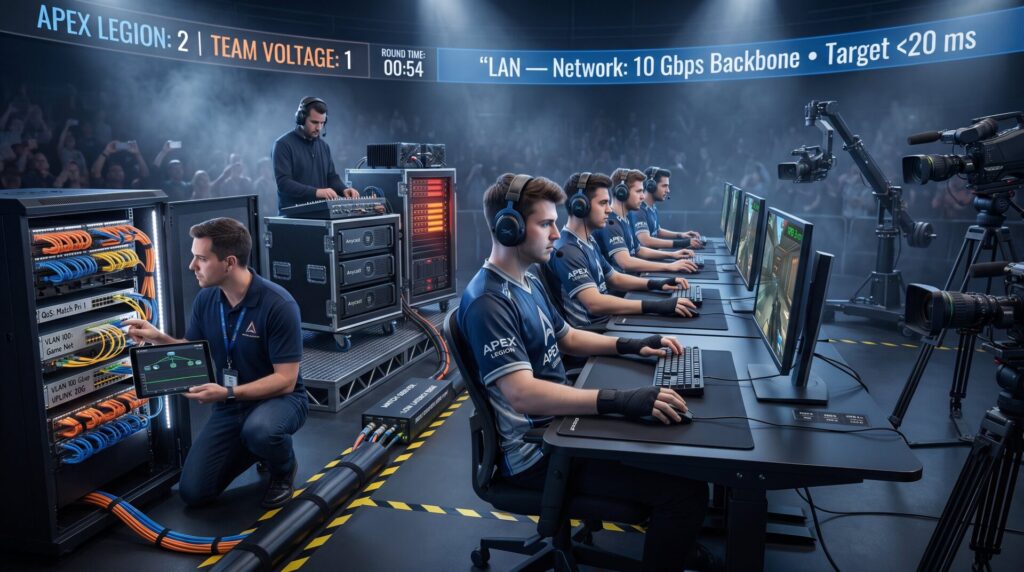
How Technology Supports Modern Esports Competition is visible in every pro match: hardware, networks, and broadcasts enable split-second outcomes. In professional play, sub‑20 ms system latency and dedicated fiber backbones decide whether a round is won or lost. This article explains why technology forms the backbone of modern esports and how specific hardware, networking, and production choices reduce lag, prevent outages, and give teams measurable edges.
Key Takeaways
- Technology is essential to modern esports, with engineered systems ensuring performance, predictability, and fairness crucial for competitive play.
- Professional esports relies on robust networking infrastructures like 10+ Gbps backbones and wired Cat6/Cat7 Ethernet to maintain latency under 20 ms and limit interference.
- Tournament-grade hardware including high-performance PCs and peripherals with ultra-low latency directly enhance player responsiveness and consistency.
- Match infrastructure combines onsite LAN servers with cloud and edge servers to prevent failures and equalize regional ping disadvantages.
- Proactive operational controls such as health monitors and automated failover improve match stability and reduce interruptions.
- Venues should audit and optimize wired station specs, backbone capacity, server topology, and peripheral latency to reduce system lag by at least 5–10 ms, advancing competitive fairness.
Why Technology Is The Backbone Of Professional Esports
Fact: Professional esports depends on engineered systems that guarantee performance, predictability, and fairness. Major events rely on 10+ Gbps internal backbones, multiple 1+ Gbps ISP links, and strict VLAN segregation so production, players, and spectators never interfere with each other. These measures cut in‑venue jitter to under 20 ms and provide redundancy when a carrier falters.
Why that matters: a single packet delay can change aim timing in a shooter or the timing of an ultimate in a MOBA. Tournament rules now mandate wired Cat6/Cat7 Ethernet for player stations and explicit ping limits (often <50 ms, frequently 0–20 ms target). Organizers also run isolated match networks to prevent packet noise and to keep broadcast and admin traffic off player paths.
Real example: at mid‑tier LANs, engineers place production servers on separate switches with QoS rules and Anycast for public streams, while match servers run on local edge appliances. That split prevents camera feeds or upload spikes from adding latency to gameplay.
Further reading: for a broad infrastructure primer that ties these pieces together, the site maintains a central technology guide with deeper sections on networking and apps in esports.
Competitive Hardware And Peripherals That Give Players An Edge
Fact: Tournament‑grade hardware reduces total system latency to under 20 ms and provides repeatable performance across all player rigs. Organizers and teams buy to a spec, not to flashy aesthetics.
Hardware choices: modern tier‑1 PCs pair high single‑core CPUs with discrete GPUs, 16+ GB RAM, NVMe storage, and 240–360 Hz 1080p monitors. Consoles used in pro circuits are configured for performance modes and wired networking. Teams often standardize parts to eliminate performance variance between stations. For a fuller overview, see the esports Technology overview.
Peripherals: players use wired mice and keyboards with 1000–8000 Hz polling rates, sensor lift‑off tuning, and <1–2 ms device latency. Manufacturers now publish device telemetry so pro coaches can compare DPI, polling, and acceleration settings across 10+ athletes.
Human detail: players notice small differences, a 0.5 ms steadiness in click timing, or a mouse with a stiffer switch that reduces accidental double‑clicks. Those tiny gains compound across a 40‑minute match.
Related reading: eTrueSports has a hands‑on look at what hardware matters most for competitive play.
Network, Servers, And Match Infrastructure
Fact: reliable match infrastructure mixes LAN servers for onsite play with cloud and edge servers for regional connectivity. That hybrid model protects matches from single‑point failures and distributes load globally.
Server deployment: onsite LAN boxes host the authoritative match state during live LAN events to eliminate internet jitter. For online regional qualifiers, edge cloud instances placed within 10–50 ms of major metro areas reduce unfair ping advantages. Matchmaking services use scalable cloud backends with telemetry streaming to ops dashboards.
Operational controls: tournaments run active-health monitors, automated failover to standby nodes, and manual switch panels to force traffic across redundant ISPs. Engineers also use packet‑capture and synthetic probes to detect microbursts and bufferbloat before they affect matches.
Internal link: this operational model aligns with the recent article about how eTrueSports tech boosts real‑time performance.
Conclusion
Insight: technology no longer hides behind gameplay: it defines competitive fairness, player comfort, and broadcast quality. Teams and organizers who treat networking, hardware, and production as coordinated systems cut measurable risk: fewer match pauses, tighter ping spreads, and steadier player performance.
Next step: venues should audit four items, wired station specs, internal backbone capacity, match server topology, and peripheral latency, and prioritize fixes that reduce total system latency by at least 5–10 ms. For an in‑depth cluster of how these systems work together and recommended tools, consult the ETrueSports technology guide linked earlier.